When people think about animation quality, they often jump to one conclusion: more frames must mean better motion. It’s an easy assumption to make, since higher numbers usually signal improvement. But in animation, that’s not always how it works.
At its core, frame rate refers to the number of individual images (frames) displayed per second. Thanks to a phenomenon known as persistence of vision, our brains blend these images together, creating the illusion of continuous motion.
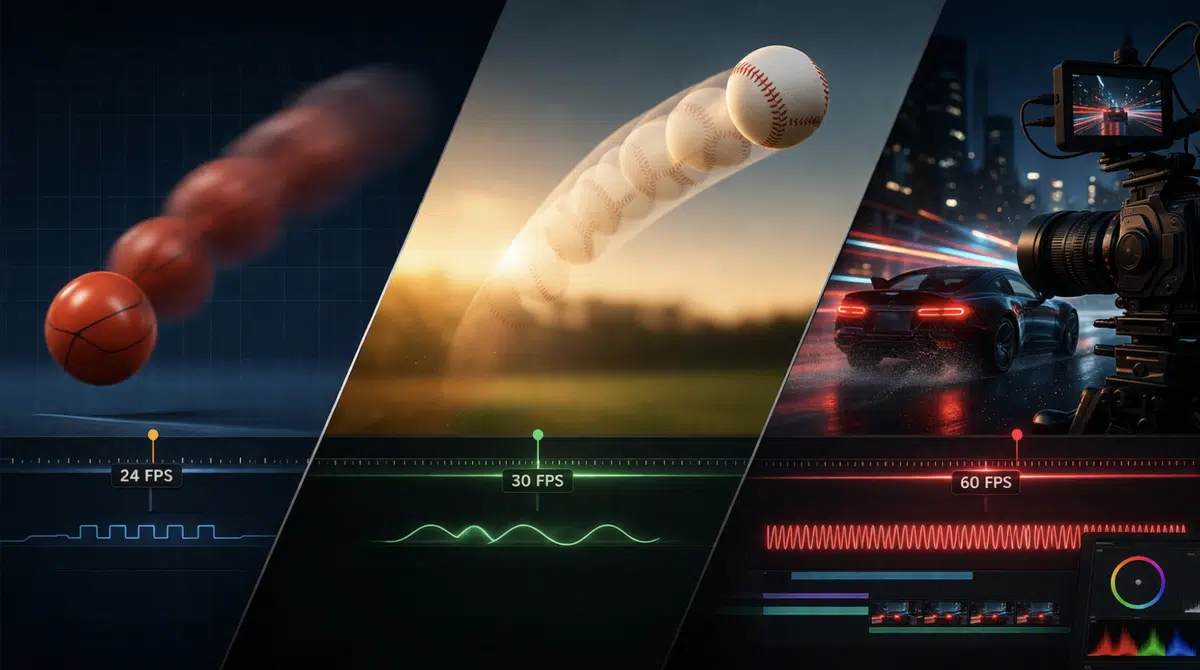
Lately, there’s been a push toward higher frame rates: 30 fps, 60 fps, even 120 fps. On paper, it sounds simple: more frames per second must mean smoother, better animation. In reality, the difference is often less noticeable than expected and can sometimes be counterproductive.
Before increasing the frame rate on your next project, it’s worth understanding what frame rate actually does and why 24 frames per second has remained the cinematic standard for nearly 100 years.
Even during the golden age of Disney animation, often considered the benchmark for craftsmanship, films were typically animated at 24 fps, with many frames shot “on twos” (meaning each drawing was held for two frames).
This approach balanced fluidity with efficiency while still delivering some of the most expressive animation ever created.
Why 24 Frames Per Second Became the Standard
In the earliest days of motion pictures, there was no fixed frame rate at all. Cameras were hand‑cranked, and silent films could be shot anywhere between about 12 and 26 frames per second, a range that simply worked well enough to trick the eye into seeing motion. But once sound was introduced to cinema in the late 1920s, it became critical that image and audio stayed synchronized consistently. Mechanical projection meant that the speed had to be uniform for everyone, everywhere.
As a result, studios settled on 24 frames per second as the standard for synchronized sound films. It was fast enough to record and play back clear audio without distortion, yet slow enough to keep production costs and film usage manageable. This balance of technical reliability, economy, and audience perception is why 24 fps became entrenched in filmmaking in the first place.
Even in the digital era, where physical film stock no longer limits frame rate choices, 24 fps persists because audiences have come to recognize and expect that cadence as part of the cinematic experience.
When Higher Frame Rates Feel “Too Real”
In recent years, several directors have experimented with higher frame rates.
Peter Jackson released The Hobbit trilogy at 48 fps, double the traditional film standard. While the goal was increased clarity and reduced motion blur, many critics and viewers said it looked overly sharp or hyper-real; more like behind-the-scenes footage than cinematic storytelling.
Ang Lee later pushed even further with Billy Lynn’s Long Halftime Walk and Gemini Man, experimenting with frame rates up to 120 fps. Technically groundbreaking? Yes. Widely embraced? Not quite.
Why the resistance? Because ultra-smooth motion can strip away the subtle abstraction that helps film and animation feel immersive rather than literal. The phenomenon is often compared to the “soap opera effect,” where motion appears unnaturally smooth and loses its cinematic quality.
In storytelling, realism and immersion are not always the same thing.
Read more about it here.
Higher Frame Rate = Better Animation?
Here’s the key distinction: frame rate is how many images are shown per second, while articulation is how much meaningful movement happens within those frames.
They’re related, but not interchangeable. You can animate at 60 fps and still have stiff, lifeless motion if the key poses, timing, and spacing aren’t thoughtfully designed. Conversely, well-articulated animation at 24 fps can feel fluid and expressive because every movement is intentional.
Increasing frame rate doesn’t automatically improve animation quality. It just increases the number of frames being displayed, which comes with production trade-offs.
- More frames to render
- Larger file sizes
- Longer export times
- Greater processing demands
There could also be some distribution trade-offs. Online, larger file sizes can slow down load times and potentially impact user experience and SEO rankings.
In production, these factors can impact timelines and budgets just as much as creative decisions.
When Higher Frame Rates Make Sense
There are situations where higher frame rates are ideal and can be very useful. Interactive media, gaming, virtual reality, and live sports all benefit from smoother motion and increased clarity, where responsiveness and precision are more important than cinematic rhythm.
In narrative animation, such as branded storytelling, character-driven pieces, and theatrical content, 24 fps remains the preferred choice. It provides emotional engagement, production efficiency, a familiar cinematic feel, and natural motion blur.
Choosing the right frame rate is about supporting the story and helping the animation feel natural and immersive for the audience.
Choosing the Right Frame Rate
Frame rate is a tool, not a shortcut. Higher numbers may look impressive, but professional animation is about the full experience, not how many frames you show.
For almost a century, 24 fps has supported storytelling in a way that feels natural and cinematic. When paired with careful articulation and key framing, it gives motion life and personality without being distracting.
The takeaway is simple. Better animation is not about more frames. It is about making the right creative choices for the story.