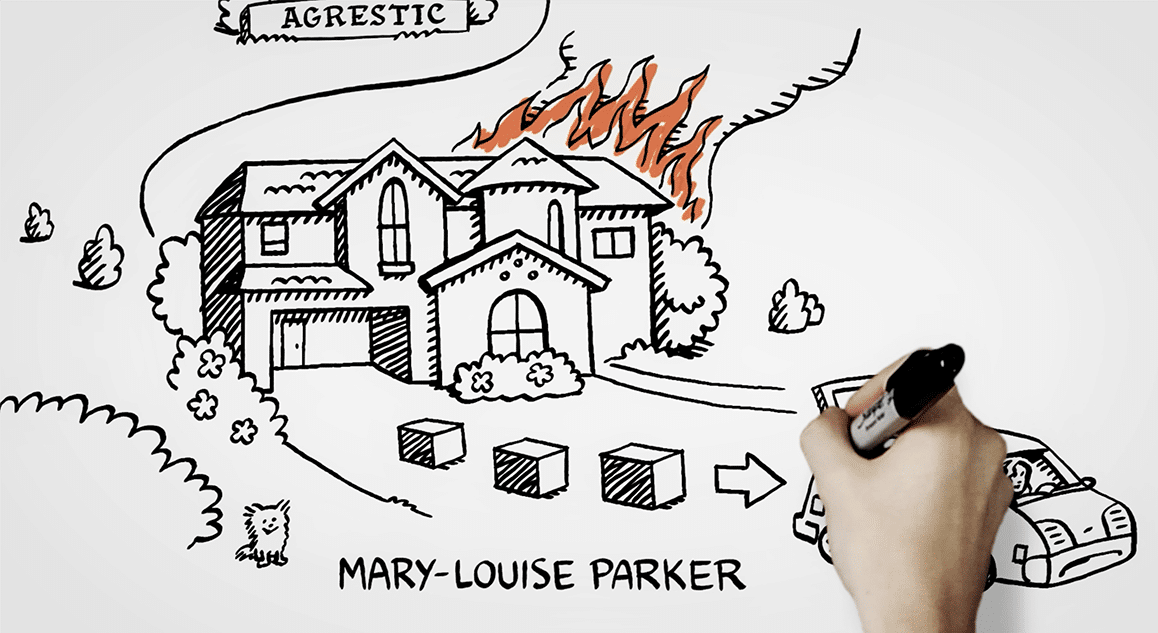
Whiteboard animation is an animation style that explains ideas using hand-drawn figures, objects, and lettering against white backgrounds. Some productions use limited color for emphasis, while many include the appearance of a hand drawing the visuals in real time. In some cases, the artwork is literally drawn on camera; in others, the hand is composed digitally to create the same effect of watching the story unfold step by step.
This animation style exploded in the mid-2000’s and has been a driving force in marketing ever since. The odds are good that you’ve seen at least one whiteboard animation. Whiteboard-style TED-Ed Talks get millions of views. Even the TV show Weeds, which we created the show-opener for. They all chose the whiteboard style to cut through the noise and communicate their message in a compelling way.
In 2026, whiteboard animation remains one of the most requested animation formats across industries, especially for explainers, storytelling, social media ads, and performance-driven content. Google Trends data suggests that interest in whiteboard animation has not only remained consistent over the past five years, but has recently begun climbing again, with several major spikes in search activity leading into 2026.
A Google Trends graph showing the interest in “whiteboard animation” in the US over the past 5 years, with fluctuating search interest and noticeable peaks and drops throughout the timeline.
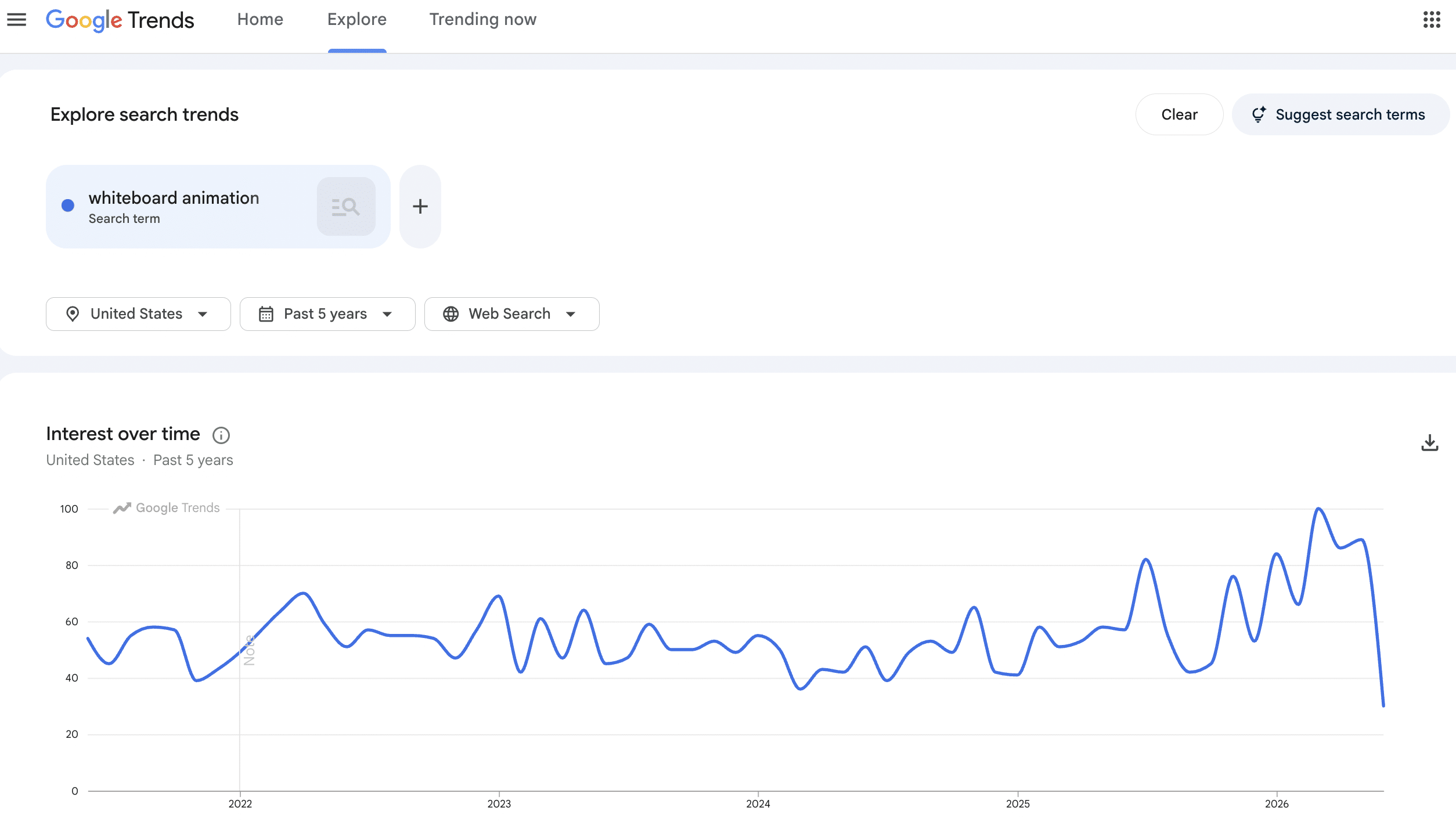
Rather than fading away, the format appears to be experiencing renewed interest as businesses continue looking for clear, engaging ways to communicate complex ideas.
Where It Started
Whiteboard animation didn’t begin as a marketing tool.
It grew out of something much more familiar: the way people naturally explain ideas. Teachers, presenters, and teams have long relied on drawing concepts step-by-step: on whiteboards, paper, or even napkins, to make information easier to understand.
That experience eventually made its way into video.
Early versions of whiteboard-style animation appeared as simple filmed drawings—literally capturing a hand sketching ideas in real time. But the format didn’t gain widespread attention until much later, when it was paired with strong storytelling.
One of the earliest and most influential examples came in the late 2000s, when Andrew Park created a series of animated talks for the Royal Society for the Encouragement of Arts, Manufactures and Commerce. These “RSA Animate” videos translated complex ideas into hand-drawn visuals that unfolded in real time, helping audiences follow along as each concept developed.
They quickly went viral and helped define what modern whiteboard animation could be. The pacing wasn’t just visual, it was functional. Viewers could follow along as each idea was introduced, built, and connected to the next. That sense of progression turned out to be powerful.
When It Took Off
It’s difficult to pinpoint the very first whiteboard animation video, but it’s much easier to identify when the style entered mainstream marketing culture.
In 2007, UPS launched a series of commercials featuring a man sketching ideas directly onto a whiteboard as he explained them. While these spots were filmed live-action rather than animated in the traditional sense, they helped popularize the visual language that would later become strongly associated with whiteboard animation.
The campaign was simple, clear, and visually distinctive. More importantly, it proved that audiences would actively watch explanatory advertising when the presentation itself felt engaging.
These short explainer ads were simple, clear, and highly effective. UPS believed in the power of simple explanation so much that they invested $35 million to create just these nine whiteboard videos.
The videos were widely described as “hypnotic” and “mesmerizing”. More importantly, they drove real business results, boosting brand awareness and helping reposition the company. In many ways, they helped spark broader interest in whiteboard animation as a marketing tool.
After that, whiteboard animation didn’t just grow—it evolved.
Startups, enterprise companies, and marketers began adopting the format to explain products, launch ideas, and simplify complex concepts. But over time, the style expanded beyond simple marker drawings. Studios started combining whiteboard techniques with traditional animation to create richer visual experiences while preserving the clarity that made the format effective in the first place.
At Idea Rocket, we’ve explored these hybrid approaches in a variety of ways.
For a campaign featuring Dare Breton gluten-free cookies, we blended whiteboard storytelling with traditional character animation to create a more cinematic feel while maintaining the immediacy of hand-drawn visuals.
For a project with PG&E, we combined whiteboard-inspired animation techniques with 3D environments, demonstrating how adaptable the format has become in modern production.
And the New York Rangers asked us to create a whiteboard-style animation introducing their new fan app, incorporating pops of the team’s signature colors throughout the piece, along with subtle planar 3D effects that added depth and dimension while maintaining the clean illustrated style.
Today, whiteboard animation is less a rigid visual category and more a storytelling approach: one that continues to evolve alongside animation itself.
Why Businesses Choose Whiteboard Animation
Companies big and small keep coming back to whiteboard videos for one simple reason: It works.
Part of its effectiveness comes from the way information is revealed gradually. Instead of overwhelming viewers with everything at once, whiteboard animation guides the audience through ideas step by step, making complex subjects easier to follow and remember.
Psychologist Richard Wiseman tested this directly in a study involving 1,000 participants. One group watched a live-action explainer about a complex topic, while another watched the same narration paired with whiteboard-style visuals.
The result: viewers who watched the whiteboard version demonstrated a 15% increase in information recall.
That combination of visual progression and storytelling remains one of the format’s greatest strengths.
4 Benefits of Whiteboard Animation
1. Demonstrating Processes
Whiteboard animation lets you present complex processes in a simple graphic format. It makes potentially dry content into interesting and engaging videos.
2. Bringing Metaphors to Life
Viewers watch you literally draw comparisons between something familiar and something new. Simple lines and motion turn abstract topics into entertaining illustrations.
3. Making Information More Accessible
Charts, graphs, statistics, and data visualizations can feel less intimidating when integrated into a simple visual narrative.
4. Capturing Attention
In a world crowded with visual noise, whiteboard animation still stands out because of its simplicity and pacing. The clean style naturally draws viewers toward what appears next.
The Future of Whiteboard
Whiteboard animation has lasted longer than most marketing trends because it solves a fundamental communication problem: helping people understand complicated ideas quickly.
As long as businesses need to explain ideas clearly, whiteboard animation will likely continue evolving alongside the broader world of animation.
If you’d like to explore what a modern whiteboard-style project could look like for your business, let’s talk.