As we enter our 15th year in business, IdeaRocket is introducing a new option for engaging our services. We call it Orbiter, and we think it’s a logical next-step evolution for corporate video, meeting the need of the moment in a new way.
To understand exactly why this is so, it’s helpful to look back at the journey many companies have taken to meet their internet video needs.
The Three Eras of Corporate Video
If you were snuggling with someone on Valentine’s Day of 2005, you probably wouldn’t know it, but something was afoot that would change corporate communications forever. That was the day that a gaggle of PayPal alums – Chad Hurley, Jawed Karim, and Steve Chen – founded YouTube. Of course, video was a communication tool before then, but YouTube changed the delivery equation completely. Now you didn’t need to send a DVD or – perish the thought – a VHS cassette to share a video. You could send a link via email or even embed that video on your site. Suddenly, video could reach many eyeballs cheaply.
The question was now: how do you produce content for the video channel? Frankly, it wasn’t a very pressing question right away. At that time, the average download rate in the USA was about 1 Mbps – today, it is over 200 Mbps. The video experience just wasn’t what we are used to now. But every year it got better, and demand grew to a dam-busting volume.
The immediate and sensible response was to outsource video production. Many local video outfits suddenly found new business customers. For tech startups, the hero asset was the explainer video. New technologies and new business models demanded explanation, and animation had a facility for communicating these concepts. IdeaRocket was part of that first-decade wave of explainer firms.
For many companies, the outsourcing model served them well. But around the middle of the teens – about a decade into the web video boom – some bigger companies started noticing that the outsourcing model introduced liabilities they did not like.
Typically, different products and departments in these companies existed in separate silos, and they hired different production companies. This created branding inconsistencies that frustrated marketing directors. Explaining to contractors how the product worked, how it spoke to customers, and who those customers were was an uphill slog that had to be climbed with every engagement – and some of the partners never reached the top of the hill. Onboarding and contracting all these companies added time and expense, and multiplied financial risk. And often, these producers would reinvent the wheel – creating a new branded bumper for their video when another company had already created a very similar asset.
In the second decade of internet video, many companies decided to take the video work in-house. The corporate video department became commonplace. Usually, these companies hired an experienced professional and maybe one or two young go-getters right out of film school. Together, they could handle most of the writing, shooting, editing, and motion graphics. And if there was a need for specialists, they could be hired as freelancers.
This solved their previous pain points, but it introduced new ones. Media production is by its nature composed of spurts. Companies found themselves paying for idle time, or being understaffed when they needed extra hands. Equipment and space costs accrued on top of healthcare, benefits, and other employment expenses. In terms of creative output, committing to a few full-timers made experimenting with the full range of techniques and approaches more difficult.
Worst of all, they had this nagging sense that they were investing in an activity that was not their core competency – and isn’t a common business competency. Video production requires a complex constellation of skills: writing, visual storytelling, cinematography, design, video editing, color correction, and sound mixing. Learning to fit these disciplines together – and manage them effectively – isn’t simple.
Your On-Demand Video Team
At IdeaRocket, we believe we are at the dawn of a third era for corporate video. Orbiter is a retainer-based model where we become a seamless part of your team – providing 2D animation, 3D animation, motion graphics, AI-generated imagery, and live action on demand. We think this will be a smoother, more powerful, and more cost-effective way for our clients to meet their video communication challenges.
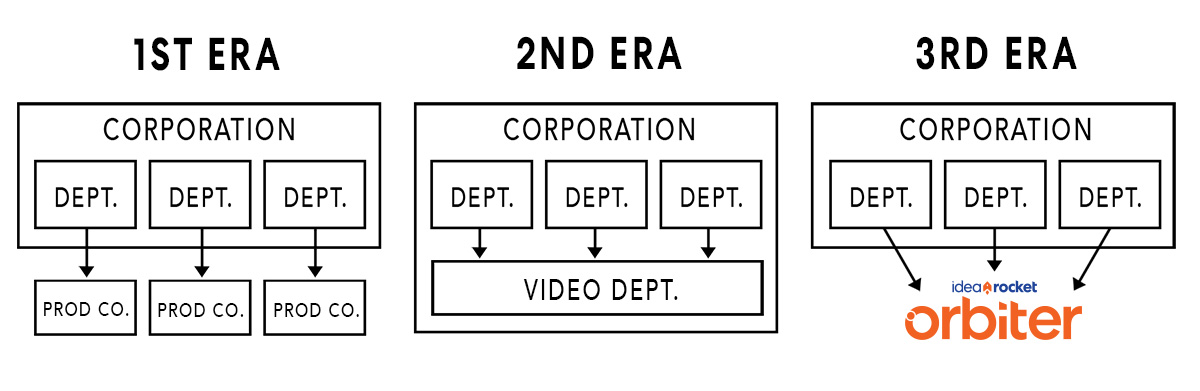
The Orbiter model solves the pain points of both the previous decades. Unlike one-off contractors, we can learn your brand, offerings, and workflow intimately. We can familiarize ourselves with – and build upon – your asset library, so work isn’t redone. We are contracted and onboarded once. And management is not asked to oversee what isn’t in their wheelhouse.
Unlike in-house departments, we can scale up and down to match demand. Our technical expertise and stylistic latitude are wider than what a narrow team can provide. And we combine cultural fluency with near-shore economies in a way that tames overhead.
So if an approach like this makes so much sense, why didn’t it happen earlier? Partly, this was the natural ebb-and-flow of a solution needing to be tried before its drawbacks became apparent. But mostly, it was because of two historic ruptures. First, the pandemic changed the work culture of both live-action and animation crews; they are now far more comfortable with – and technically equipped for – remotely directed productions. Then came another revolution: AI-generated imagery made it possible to create photo-realistic depictions of companies’ people and places without the need for a shooting crew. The time is ripe for this solution.
However, to say that Orbiter is just about producing better video is understating our ambition. We want to become your strategic partner. That means not just fielding projects, but building a program.
The first step is sitting down to discuss your workflow from project intake to video distribution and measurement. We can help you set up a planning and measurement system that can tell you where to spend and where to keep it lean. It can create a learning loop that lets us work smarter – and lets you hold us accountable.
If you think this offering is worth exploring, let’s talk. You can reach out directly to me at [email protected].