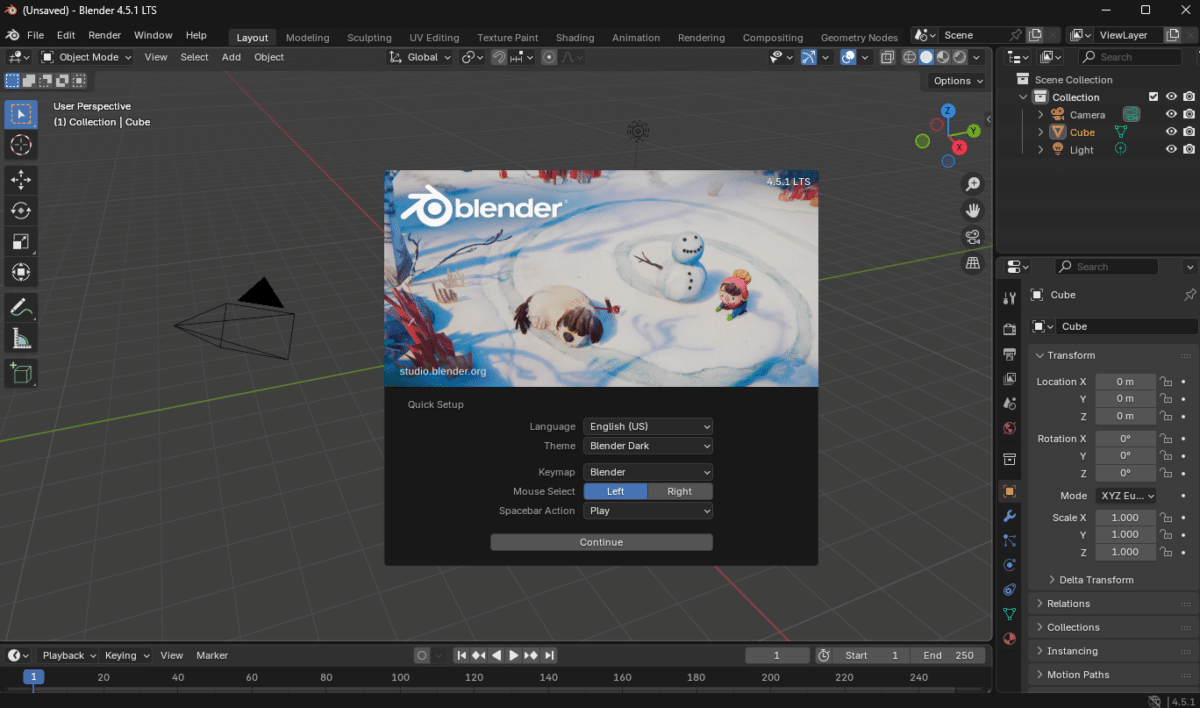
One 3D animation suite has become the go-to for new animators and budget-conscious freelancers, as well as studio professionals. Blender is free and open source animation software built on the concept of accessibility for all. This community-driven project evolves with the needs of its robust community of developers, users, and makers.
What is Blender?
Blender is more than a free, open source 3D animation software. It is also a community project funded by donations and coordinated by the Blender Foundation. Anyone can use, modify, and share the Blender code. Both the software and the code can be downloaded free of charge from Blender.org.
This cross-platform software runs on Mac, Windows, and Linux. It can run without a full install and without internet access, making it uniquely portable and accessible.
What Can Blender Do?
If it’s related to 3D modeling and animation, Blender can probably do it. From sculpting and modeling to animation and rigging, to video editing, Blender is an all-in one tool for 3D animators.
Grease Pencil Objects are Blender objects that enable the creator to draw in the 3D space. They can be used to storyboard or make various types of animation. Powerful simulation tools and VFX capability is built in.
Blender integrates with multiple pipeline tools. The Python API gives users the ability to script and customize every tool within the suite. Users can even customize window layout and shortcuts to match their preferred work style.
Users have created original movies, transformed 2D drawings into 3D models, rendered artwork, and crafted commercials. Recently, Blender Studio released its game project, Dog Walk.
The Blender Origin Story
A Dutch art director named Ton Roosendaal created Blender in January 1994. Although he originally created it to be an in-house application for his 3D animation studio, NatGeo, he soon started distributing it under a freemium model through a company known as Not a Number.
When Not a Number folded, Roosendaal wanted a new way to distribute Blender. He created the Blender Foundation, a non-profit, and transformed Blender into an open-source tool. Then and now, it operated under the GNU General Public Licence.
Although it is maintained by a core team within the Blender Foundation, a global community of volunteers contributes to its ongoing development. In addition, the Blender Institute uses open-source tools to create original projects like the Dog Walk game (above) and the animated short Sprite Fright linked below.
The Blender Community
Blender community members, sometimes called Blenderheads, contribute to documentation, design, code, testing, QA demo files and Blender modules. To facilitate this work, the platform hosts a Developer Forum and a community chat with multiple rooms to explore. The Right-Click Select forum provides a space for users to share and discuss ideas for new features and bring them to the attention of Blender developers.

Aside from these Blender-hosted spaces, the platform also shares a list of independent Blender groups hosted on forums and websites all over the world. Millions of users participate in the StackExchange and Reddit forums. You’ll also find Blender on popular social media platforms like X, Instagram and LinkedIn. From sharing finished work to getting answers to common questions, the Blender community is robust.
Blender even hosts an annual event known as BCON to bring the community together. BCON 2025 will be held Sept 17-19 in Amsterdam. The submission deadline for the associated Suzanne Awards Animation Festival is August 29, 2025.
Should New Animators Use Blender?
Although it lacks the professional acceptance of a software like Maya, Blender has long been a standard industry tool. However, it does have its drawbacks. Touching the entire 3D pipeline means that it can’t possibly excel in every area. It’s usually possible to find a paid tool that does the same function better. Some users are frustrated by the suite’s reliance on plug-ins and add-ons.
One important caveat for new and aspiring animators is that Blender does things a little differently. This means that it’s great for building core animation skills and a storytelling mindset, but may not help you learn the technical skills required by animation studios that rely on paid options like Autodesk Maya, Houdini, and Cinema 4D
Ultimately, though, Blender is a powerful, free tool that makes 3D animation tools accessible to all. Learning to animate in Blender can help new animators develop their skills and get comfortable with 3d animation.
Does Blender Use AI?
Blender is just starting to dip its toes into the AI pool. At the last BlenderCon, developers announced that Blender would be incorporating some AI. It’s already in place for the image denoiser.
In the future, AI will be used in unwrapping and texturing. Developers also forecasted the use of a large language model to write Python scripts.
This might be just the beginning, but Blender seems to be approaching AI with caution. Their goal is to empower artists, and AI that takes away jobs or makes the software harder to use doesn’t align with that mission.
The Key Takeaway
Ultimately, what you need to know about Blender is this: It’s a free, open-source tool and community that makes 3D animation accessible. Many have learned from it and created with it. The suite will continue to evolve, guided by its users and developers. If you’re interested in learning animation, Blender is a great place to start.